Why every body image workshop you've run probably failed (and what works instead)
Why every body image workshop you've run probably failed (and what works instead)
Let me guess, you've run body image workshops…
You brought in external speakers, created safe spaces for discussion, distributed worksheets on social media. Participants said it was "really helpful." They left feeling momentarily uplifted. Some even approached you afterwards and cried — the good kind of crying, the cathartic kind.
And then, a month later, nothing has changed.
The same young people are still picking themselves apart in reflections and skipping meals. The same anxious avoidance of photos, sport, speaking up. The same gravitational pull back toward self-scrutiny and silence. The same teasing and banter in the classroom about weight, acne and looks.
Here's the uncomfortable truth: many body image and eating disorder prevention programmes don't work.
In meta-analyses, where researchers statistically analyse the impact of dozens of body image programmes, most show no impact and many show only short-term changes.
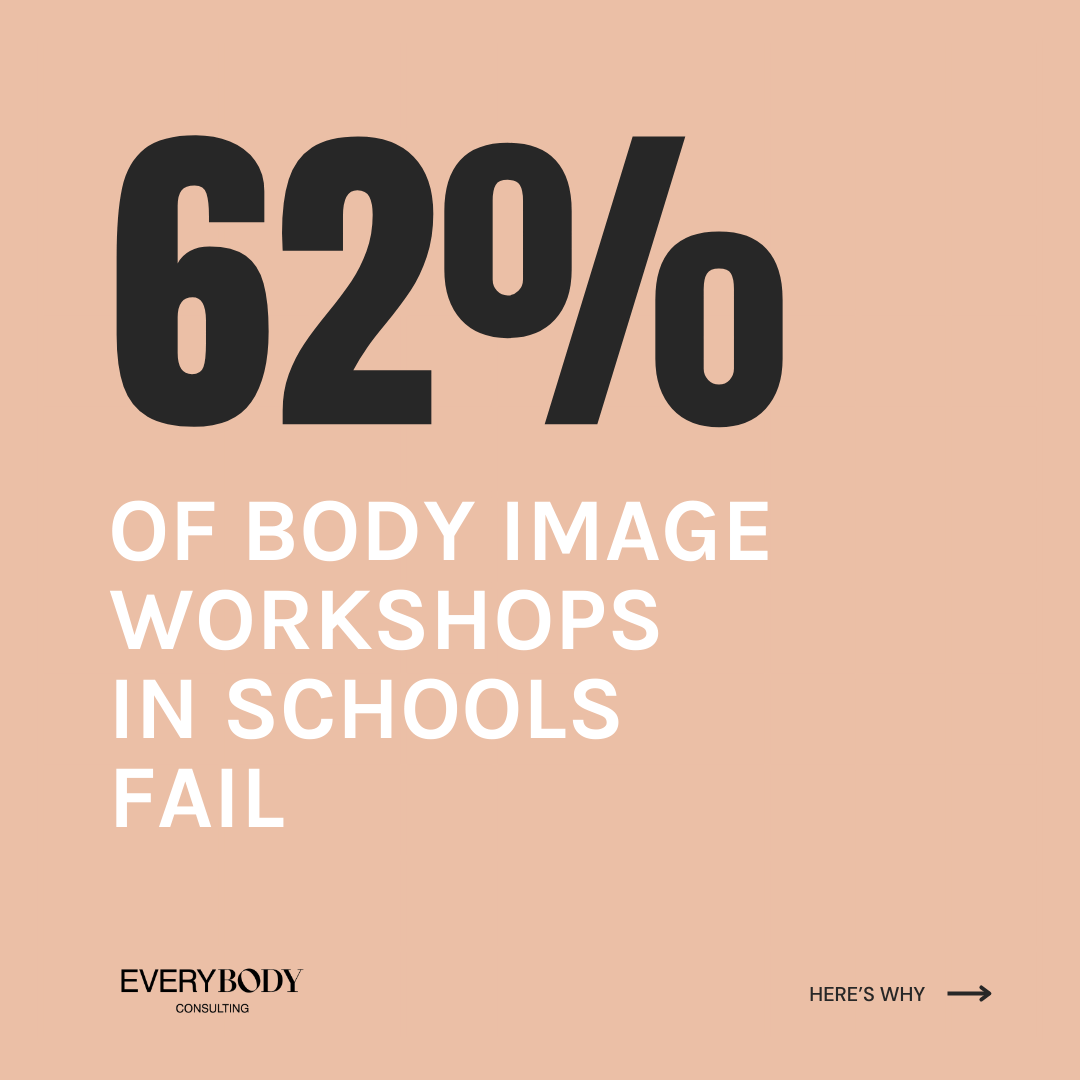
For example, in a recent journal article researchers reviewed over 2000 studies. They found around two thirds (62%) of school body image programmes had no significant impact on improving body image.
Not because teachers and facilitators aren't trying, they absolutely are. Not because participants don't want to change, they desperately do. But because the way we've been taught to approach body image is often misaligned with how attitudes and behaviours actually shift.
We've been treating body image and eating disorders like a knowledge deficit. And knowledge, on its own, changes almost nothing.
Why awareness raising isn’t enough to improve body image and prevent eating disorders
The most common approach to workshops on body image goes something like this: educate young people about unrealistic beauty standards on social media, explain how airbrushing and filters work and affirm that "all bodies are beautiful" through a feel-good exercise, and hope that this translates into real changes in their confidence.
It sounds logical. It feels good.
And, it achieves almost nothing lasting.
Why? Because many young people can already recognise that beauty standards are unrealistic. They can intellectually understand that Instagram is curated, that TikTtok is a sea of filtered videos, that the "ideal" body is statistically rare and culturally constructed. Ask most 14-year-olds, and they'll tell you, with impressive clarity, that beauty standards are arbitrary and harmful.
And then they'll go home and spend two hours choosing a selfie for Instagram, angling for the thinnest possible version of themselves on Snapchat, or watching the latest gym-bro muscle building tips on YouTube.
This isn't ignorance. It's not vanity.
It's the gap between knowing something intellectually and believing it emotionally and having the skills to act on it behaviourally. And that gap is where most body image interventions die.
Awareness-based approaches assume that if people understand the problem, they'll stop participating in it. But belief systems don't work like that. You know that eating 5 portions of fruit and vegetables everyday is the gold standard. You know that you should go to the dentist for a check-up once a year.
Likewise, you can know that diet culture is toxic and still find yourself mentally calculating calories. You can know that beauty is socially constructed and still feel fundamentally inadequate when you don't measure up to the glassy skin trend on social media.
Because the issue isn't what people know. Scientists have stated for years that knowledge is enough to change human behaviour. It's what they've internalised, often without realising it, and the systems and environment they live in, which can be hard to change.
The problem with positive self-love affirmations
The second most common strategy is affirmations. "My body is beautiful." "I am enough." "Love yourself."
Again: well-intentioned. But, very small impact and often not enough on their own to deliver lasting improvements to body image.
Affirmations ask people to override deeply entrenched beliefs through sheer force of repetition. They can have But if someone genuinely believes their body is unacceptable or they have a fear of getting fat and skip meals as a result, telling them to "love it anyway" doesn't resolve the underlying dissonance, it just creates another thing they're failing at.
It's like painting over a crack. The wall looks better for a while, and you feel like you've done something. But the thing underneath keeps growing, until the wall crumbles.
Worse, affirmations often feel hollow precisely because they're at odds with lived experience, especially for people who are struggling with disordered eating and appearance anxiety. If you've spent years receiving subtle and not-so-subtle messages that your body is wrong, from peers, media, family, the built environment that literally doesn't accommodate you, then being told "you're beautiful just as you are" doesn't always land as liberation. It lands as an a utopian goal.
The intention is kindness. But the outcome is often shame layered on top of shame.
I should love my body. Why can't I? What's wrong with me?
What actually changes body image beliefs and behaviour: the power of cognitive dissonance
So if awareness doesn't work and affirmations act like a bandaid, what does?
The answer lies in a psychological principle called cognitive dissonance, the uncomfortable tension we feel when our actions contradict our beliefs.
And rather than avoiding that mental discomfort, the most effective body image intervention in the world deliberately creates it and guides participants through exercises to overcome it.
The Body Project, developed over 20 years of research and tested in over 100 randomised controlled trials by research groups around the world, doesn't tell participants what to think. Over 4-hours of small group sessions, it invites them to actively critique appearance ideals and pressures — out loud, in writing, through role-play, letter writing, interactive activities and discussion, with their peers.
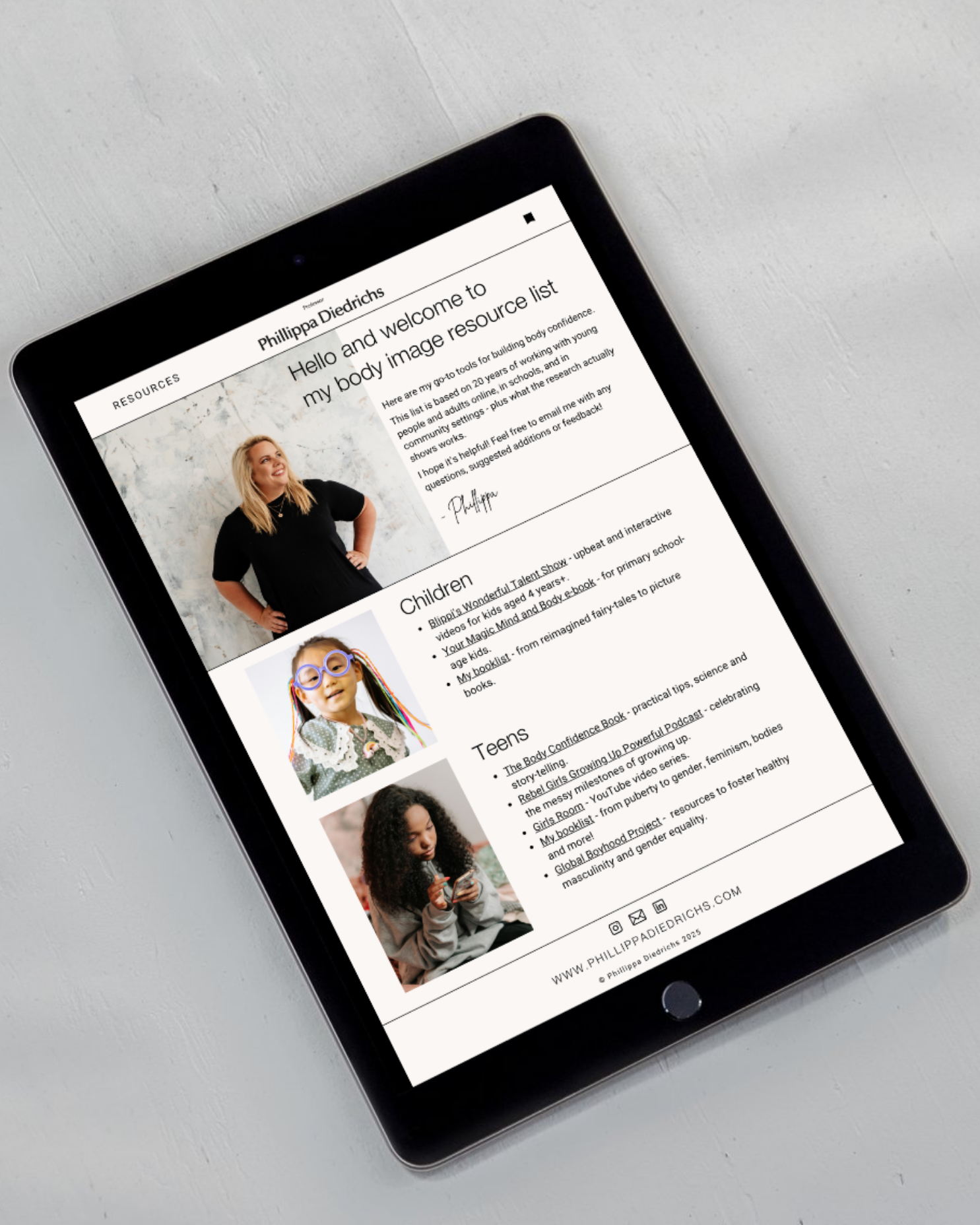
FREE BODY IMAGE RESOURCES
Download our go-to, evidence-based body image resources: carefully selected by body image expert Professor Phillippa Diedrichs, PhD
Here's how it works:
Participants write counter-attitudinal letters to their younger self on why pursuing appearance ideals is harmful to their well-being.
They role-play refusing body talk and practice challenging appearance-focused comments from friends and family
They articulate publicly and repeatedly why beauty standards are unrealistic, unfair, and damaging
They engage in group discussions where they practice how to take action to change their environment through body activism
Here's what happens:
By having the space and support to argue against the appearance ideals they've internalised, they start to actually believe what they're saying. The disconnect between thinking "I've been pursuing this ideal" and saying it’s harmful in front of a group of peers creates psychological friction, or what psychologists call ‘cognitive dissonance’. And to resolve that friction and relieve the mental discomfort, their belief systems begin to shift — not at the surface level, but structurally – so that they match what they’re saying and doing. They begin to reject unhelpful appearance ideals and thoughts that they’re not going enough, and instead start to feel greater body satisfaction and self-esteem.
This isn't about awareness raising. It's about active, public, repeated counter-advocacy to change attitudes and behaviours.
The research evidence shows it works:
60% reduction in eating disorder risk
Significant, sustained decreases in body dissatisfaction
Lower internalisation of appearance ideals
Better mood and self-esteem
Effects lasting at least 2-3 years post-intervention
“For every 100 girls who complete The Body Project, 8 cases of eating disorders are prevented.”
That's not a temporary mood boost. That's a fundamental change.
Why most body image workshops can't replicate this
You might be thinking: Right, so I'll just add some critical thinking exercises to my workshop. Done.
It's more nuanced than that.
The reason The Body Project works isn't just the activities, it's the methodology. The structure. The expert-created manuals and worksheets. The facilitation training and skills. The way dissonance is carefully built and sustained over multiple sessions, not rushed into a one-off workshop.
Most body image interventions try to do too much in too little time. A single session. Maybe two. Participants are asked to absorb information, share vulnerably, challenge their thinking, and leave transformed. It's the emotional equivalent of speed-dating — intense in the moment, but rarely life-changing.
The Body Project runs over four brief sessions, with specific exercises designed to deepen dissonance incrementally.

Facilitators receive experiential evidence-based training — not just a script, but comprehensive preparation in how to:
Have the confidence to tackle sensitive topics
Hold space for participant discomfort as they develop new ways of thinking without rushing to resolve it
Encourage participant-led critique rather than expert-led instruction
Recognise when appearance biases emerge and know how to gently challenge them
Manage group dynamics and individual resistance so that everyone feels included and respected
This level of rigour, decades of scientific research, and the ongoing integration and updating of materials based on input from young people, health professionals and community members is why it's been replicated and adopted successfully across universities, healthcare settings, schools, and youth organisations worldwide. It's not magic. It's methodology, theory and precision.
"But We Don't Have Time for Four Sessions"
This is the most common objection, and it's understandable. Schools and youth services are stretched. Time is precious.
But here's the question: would you rather run something once that works, or repeatedly run something that doesn't?
A one-off workshop might feel efficient. But if participants leave unchanged—if you're running the same "body confidence" session year after year with no lasting impact—you're not saving time. You're wasting it.
Four sessions, delivered properly, create change that lasts years. That's not an inefficiency. That's an investment.
And, there are proven versions of The Body Project that you can use to suit your needs. Need 45-minute sessions to fit into class timetables, use the 6 x 45-minute version of the programme. Need a format that suits community youth groups and doesn’t feel like school lessons, there’s a version for that. Need a version that suits diverse groups of students from varied genders, sexualities and ethnic backgrounds - there’s a version for that too.

What this means for your practice
If you're a teacher, psychologist, school nurse, youth worker, counsellor, dietitian, coach, or wellbeing lead who's been delivering body image workshops and eating disorder programmes, and you’ve been feeling quietly frustrated by the lack of lasting impact, this isn't a failing on your part.
You've been working within a paradigm that was never going to deliver what you hoped. Not because you're doing it wrong, but because the model itself is insufficient.
So what now?
If you want to create real change:
You need interventions that go beyond awareness and affirmations. You need structured evidence-based tools that engage cognitive dissonance, provide you with the right training, that give participants time and space to genuinely challenge, not just intellectually acknowledge, the beliefs they've internalised, and that are proven to create positive body image and prevent eating disorders.
If you're not ready to implement The Body Project yet:
As a starting point, stop relying on one-off workshops that prioritise feeling good in the moment over changing beliefs long-term and lack evidence to show they work.
Body image work requires evidence-based approaches and the research shows you won’t see long-lasting change from a single conversation. It's a process. And processes require proven tools and manuals, scaffolded learning activities, opportunities for practice, and skilled facilitation.
Get comfortable with discomfort:
Research suggests that interventions requiring multiple brief sessions are significantly more likely to produce lasting change than those that prioritise one-off workshops. If your workshops feel too surface-level, too uniformly positive, they're probably not creating the psychological changes necessary for genuine behaviour change.
The Work That Actually Works
Body image and eating disorders are a quiet public health crisis, social justice issues, and profoundly personal struggles for millions of young people. We owe them more than well-meaning workshops that achieve nothing.
We owe them interventions that actually work. Evidence-based programmes. Appropriately trained and supported facilitators. Structural changes alongside individual support.
The good news? Those interventions exist. The evidence is robust. The methodology is proven. You can be trained to deliver them in just a few hours.
The question is whether we're willing to let go of what feels right in favour of what actually works.
Because the young people sitting in your workshops deserve better than temporary catharsis. They deserve foundational change. And that requires us to stop doing what's failed before, and start doing what the evidence shows succeeds.
Ready to move beyond body image workshops that don't work?
At EVERYBODY, we train individuals and teams to deliver The Body Project; the most rigorously evaluated and science-backed body image and eating disorder prevention programme in the world.
Our training is designed for:
Teachers, school nurses and pastoral staff
Youth workers and community practitioners
Counsellors, psychologists and mental health professionals
University wellbeing teams
Any community member committed to evidence-based body image work
What makes our training different:
✅ Grounded in 20+ years of peer-reviewed research
✅ Comprehensive facilitator training (not just a manual to download)
✅ Ongoing implementation support and troubleshooting
✅ Access to a network of trained practitioners and community discussion
✅ Proven methodology with measurable outcomes
One day of training. Years of impact.
Meet the author

Professor Phillippa Diedrichs, PhD, is a social scientist on a mission to ensure no one is held back by how they look, their gender or identity. She’s a global expert on body image, mental health and inclusion, working with leading brands, governments, women and young people to drive meaningful social change.
Phillippa is the Founder of EVERYBODY Consulting and a Professor of Psychology at the Centre for Appearance Research and a Body Project Master Trainer.